
"After testing platforms for Canadian players over the last few years, the main takeaway is simple: never jump into real-money tables without understanding the mechanics first. Free online poker is your safest testing ground to learn the rules before depositing." - Reid Calloway, Independent Casino Analyst

The learning curve in any poker format calls for structured practice, not pure guesswork. Before you risk a single dollar of your bankroll, you need to understand how the core rules, combinations, and basic strategies actually function in a risk-free environment. Play responsibly (19+), and use free tools to get comfortable with the digital felt. Here is what that means for you in practical terms.
In this guide you will learn:
- What poker is and how the online version differs from a live card game
- The full step-by-step flow of a Texas Hold'em hand, from blinds to showdown
- Every poker hand ranked from High Card to Royal Flush (with probabilities)
- Essential glossary terms every beginner must know before sitting down
- Core strategic concepts: position, pot odds, value bets and bluffs
- The most popular poker game variants online
- How to get maximum training value from free poker platforms
- Frequently asked questions about RNG fairness, disconnections, and Canadian safety
What Is Poker and How Does Online Poker Differ from a Traditional Card Game
Online poker is a digital adaptation of the classic card game, processing 80 to 100 hands per hour compared to the 20 to 30 hands you would see at live traditional tables. The core difference comes down to software automation, game pace, and the absence of physical player interaction.
Digital platforms automatically handle shuffling the card deck, dealing the playing cards, and calculating the pot in real time. That eliminates human error in chip counting and card handling. Because players are not face-to-face, you cannot rely on physical tells. Instead, your strategy leans on betting patterns and timing. This format lets you play poker across multiple tables simultaneously, which greatly increases the pace. Online players on average face more complex decision points per hour than live players. That accelerates pattern recognition, though it can reduce reflective thinking about each individual spot. The transition to playing poker games on a screen means all math is tracked for you, freeing you to focus purely on your next move. For a broader look at how digital gaming platforms operate, explore iGaming environments and their technology stack.
Comparison of real-money online poker, free online poker, and traditional live card game formats for beginners
| Criteria | Online Poker (Real Money) | Free Online Poker | Live Card Game (Offline) |
|---|---|---|---|
| Entry & Barrier to Start | Requires verification and CAD deposit (19+). | Instant access via apps; no deposit required. | Requires physical travel to a casino or card room. |
| Pace (Hands per hour) | Fast (80-100 hands per hour). | Fast (80-100 hands per hour). | Slow (20-30 hands per hour); relying on a manual dealer. |
| Learning Environment | High pressure; mistakes cost actual money. | Zero pressure; ideal for testing betting mechanics. | Social but intimidating for absolute beginners. |
| Focus for Players | Bankroll management and exploiting real opponents. | Memorising hand rankings and the flow of a hand. | Reading physical tells and social dynamics. |
| Multi-tabling | Yes, 4 to 24 tables simultaneously. | Yes, most apps support multiple tables. | No, one table only. |
The short version: online poker free formats give you the same rules and the same card logic, just without the deposit barrier and at roughly three to four times the speed of a live game. That speed is your biggest training advantage.
Why Free Online Poker Is the Best Starting Point
Free online poker provides a low-pressure environment where players can practise fundamental mechanics without monetary risk. This zero-risk format is heavily recommended for beginners who want to memorise rules and test betting actions before advancing to anything with real stakes.
When you play poker online free, you experience the exact same game logic, the way poker is organically structured, but with play-money chips. Players can test whether to fold, call, or raise without stressing over their balance. It is, frankly, the closest thing to a flight simulator for card games.
Free poker rooms allow beginners to study rules and practise basic actions - fold, call, raise - in a fully risk-free setting. - "Free Online Poker As A Learning Environment: Empirical Evidence And Practical Guidance" (2024)
Platforms like PokerStars (Play Money mode), WSOP Free Poker app, and Zynga Poker all provide step-by-step tutorials and play-money tables that mirror real game mechanics. No deposit or credit card is needed. Just download the app, create a free account, and choose a play-money table. For those who prefer browser-based play without downloading anything, 888poker's Practice Play Lobby offers instant access.
In one recent platform evaluation, a user struggling with turn order exclusively used a free app for three days. They completely eliminated out-of-turn mistakes when they finally transitioned to real money. Small detail, big difference.
However, even risk-free environments carry behavioural considerations. The ease of online play can blur time awareness and encourage impulsive session lengths. Those habits become costly once real money enters the picture.
Even in free formats the online environment can amplify dissociation and loss of time awareness, especially given the easy transition to real-money stakes. - "Free Online Poker As A Learning Environment: Empirical Evidence And Practical Guidance" (2024, behavioural risk section, BMJ data)
Players drawn to asymmetric payouts (chasing that rare big pot) may also reinforce unrealistic expectations during free play, making the psychological transition to real money more difficult.
Players prone to skewed payout preferences may lock in unrealistic expectations in free poker, complicating the shift to real stakes. - "Skewness Preferences: Evidence from Online Poker," ScienceDirect
Disclaimer: This article is for general informational purposes only. Playing poker, including free formats, can develop gambling habits. Play responsibly (19+), set session time limits, and seek support if gaming becomes compulsive. In Canada, provincial regulators such as iGaming Ontario and the AGCO oversee legal online gaming; always verify a platform's licence before depositing real money.
How to Play a Poker Game: Basic Rules and the Flow of a Hand
A standard poker game follows a strict sequence: posting blinds, receiving hole cards, dealing community cards across three phases, and concluding with a showdown. The rules dictate exactly how each player interacts during these progressive betting rounds. Because this sequence is the foundation of everything that follows, hand rankings, betting decisions, strategy, it makes sense to learn it first.
[IMAGE: Flowchart of a Texas Hold'em hand. Caption: "Step-by-step deal flow in Texas Hold'em." Style: monochrome, step-by-step structure from preflop to showdown. Alt text: "card dealing sequence in texas hold em from blinds through preflop flop turn river to showdown."] Purpose: Simplifies comprehension of the game sequence so a new player can follow along during their first hands.
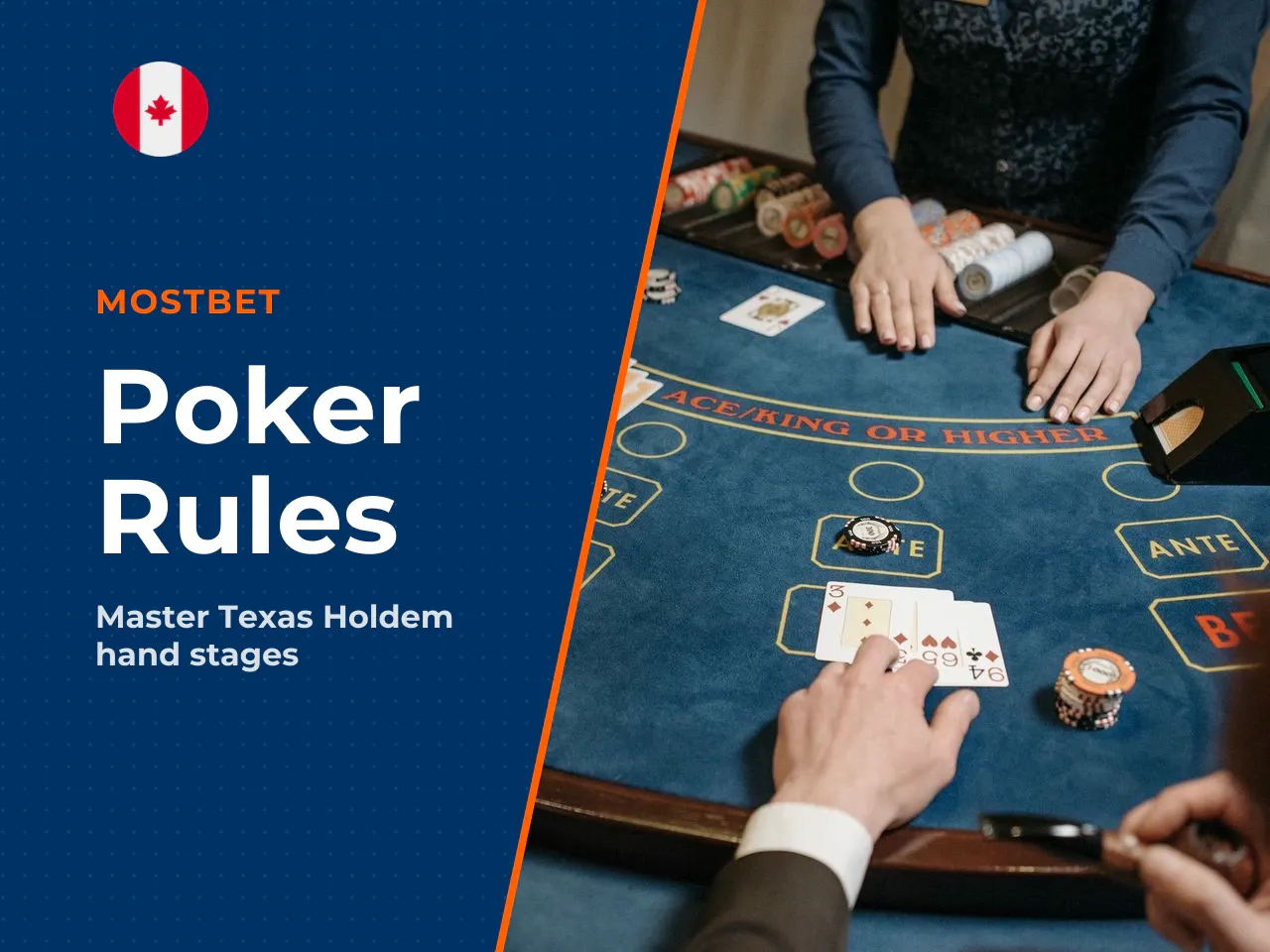
Step-by-Step: How a Texas Hold'em Hand Plays Out
Rather than describing the entire sequence in a single paragraph, here is the hand broken into discrete stages. Each stage adds cards, information, and a fresh round of betting. Players start every hand from the same structured sequence.
- Post Blinds. The two players to the left of the dealer button place mandatory bets: the small blind (half the minimum bet) and the big blind (the full minimum bet). The positions of the dealer, small blind, and big blind rotate clockwise after every hand.
- Preflop: Receive Hole Cards. The dealer distributes two private face-down cards (called hole cards) to each player, starting with the small blind and moving clockwise. A round of betting begins with the player to the left of the big blind. Each player must decide to call, raise, or fold based solely on their two cards.
- Flop: First Three Community Cards. The dealer burns one card (discards it face-down) and then places three cards face-up in the centre of the table. These are community cards, shared by all players. A second betting round follows, starting with the first active player to the left of the dealer.
- Turn: Fourth Community Card. The dealer burns another card and deals a single card face-up next to the flop. A third betting round occurs.
- River: Fifth and Final Community Card. The dealer burns one more card and places the final community card face-up. A fourth and final betting round takes place. At this point, five community cards sit on the board.
- Showdown. If two or more players remain after the river betting, they reveal their hole cards. The player who made the last aggressive action (bet or raise) on the river shows first; the rest follow clockwise. The best five-card hand wins the pot.
- Single Winner Before Showdown. If all opponents fold at any stage, the last remaining player wins the pot immediately and does not have to reveal their cards.
In Texas Hold'em, after two closed cards are dealt, four rounds of betting follow, tied to the reveal of community cards on the flop, turn, and river. - "Free Online Poker As A Learning Environment: Empirical Evidence And Practical Guidance" (2024)
Hole Cards and Community Cards: Which Cards Belong to the Player
The two hole cards are private and visible exclusively to you, whereas community cards are dealt face-up in the centre for all players to share. All players combine their private holdings with the shared board to create a final hand.
Every card is vital when constructing a card poker hand. The community card setup means multiple opponents might rely on the exact same strong visible cards. You must always account for how a single community card benefits the other players, not just your own two cards. This is where beginners often stumble. They see their own hand in isolation and forget the board helps everyone.
An important nuance many beginners miss: in Texas Hold'em, a player can use both hole cards, only one, or even neither. You can assemble the best five-card hand purely from the community board if those five cards happen to outrank any combination that includes your hole cards.
In Texas Hold'em a player may use both hole cards, one, or "play the board," forming the best hand entirely from community cards. - "Free Online Poker As A Learning Environment: Empirical Evidence And Practical Guidance" (2024)
Beginner Glossary: Terms You Must Know Before Your First Hand
Poker has its own language. Before you sit down, even at a free table, understanding the following terms eliminates confusion and helps you act confidently in turn.
| Term | Definition |
|---|---|
| Blinds | Mandatory bets posted before cards are dealt. The small blind is half the minimum bet; the big blind is the full minimum. |
| Ante | A forced contribution from every player into the pot before the hand starts, used in some tournament formats. |
| Check | Pass your action without betting. Only possible if no bet has been made in the current round. |
| Call | Match the current bet to stay in the hand. |
| Raise | Increase the current bet, forcing opponents to match or fold. |
| Fold | Discard your hand and forfeit the current pot. |
| All-In | Bet every chip you have on a single action. |
| Button (Dealer) | A marker indicating the nominal dealer. The player on the button acts last in every post-flop round, a significant advantage. |
| Pot | The total amount of chips wagered by all players in a hand. |
| Kicker | The highest unmatched side card used to break ties when two players hold the same main combination. |
| Showdown | The final reveal of hole cards after the river betting round, where the best hand wins. |
Memorise at least these eleven terms before your first session. They appear in every hand and every strategy discussion that follows.

Betting Basics: When to Call, Raise, or Fold
Betting decisions are not random guesses. They are rooted in mathematical risk versus reward. Here is a simplified decision framework for beginners:
- Call when your estimated probability of winning exceeds the price the pot is offering you. In mathematical terms: call when Win% > Call Amount / (Pot + Opponent's Bet + Your Call). If the pot is 100 chips, your opponent bets 50, and you need to call 50, you need to win more than 25% of the time to break even.
- Raise when you hold a strong hand and want opponents with weaker hands to put more chips in (called a value raise), or when you believe your opponent will fold a better hand (called a bluff raise). A standard preflop raise size is 3x the big blind.
- Fold when your hand has near-zero chance of winning at showdown and near-zero chance of making your opponent fold. Most beginners underestimate how often they should fold. In your first sessions, folding 70 to 80% of starting hands is healthy, not passive.
The Two Purposes of Every Bet
- Value: You want opponents with worse hands to call, growing the pot in your favour.
- Bluff: You want opponents with better hands to fold, surrendering the pot to you. Understanding why you are betting is more important than the bet size itself.
In no-limit formats the bet size is unrestricted, which dramatically increases variance and demands stricter emotional and mathematical discipline compared to limit games.
"In no-limit formats the unrestricted bet size sharply increases variance, requiring stricter control of probabilities and emotions." - "Free Online Poker As A Learning Environment: Empirical Evidence And Practical Guidance" (2024)
A practical approach for your first 100 hands: adopt a strict "raise or fold" preflop policy. Avoid limping (just calling the big blind). When a beginner switches from limping into every pot to only raising with premium hands or folding, their results tend to stabilise quickly. The reason is straightforward: they stop investing chips in weak positions.
Poker Hands: How the Best Five-Card Hand Is Determined
The winner at showdown is determined by whoever holds the best five-card hand out of the seven available cards (two hole cards plus five community cards). If players hold identical main combinations, the highest unmatched card, the kicker, breaks the tie. Suits never break ties in standard poker; only card ranks matter.
Poker hands range from a simple high card to the exceptionally rare Royal Flush, which carries a probability of just 0.000154% (4 possible combinations out of 2,598,960 total five-card deals). Whether you land a pair (two cards of the same rank), three of a kind (three cards matching), four of a kind (four cards matching), or a flush (five cards of the same suit), the system automatically evaluates your strongest five cards.
Poker payouts have a pronounced asymmetry: small losses are frequent while large wins are rare, statistically described as positive skewness of the distribution. - "Skewness Preferences: Evidence from Online Poker," ScienceDirect
Standard Poker Hands Ranked from Highest to Lowest (with probabilities for a 5-card deal from a 52-card deck)
| Rank | Hand Name | Description | Example | Probability |
|---|---|---|---|---|
| 1 | Royal Flush | A-K-Q-J-10 of the exact same suit. | A♠ K♠ Q♠ J♠ 10♠ | 0.000154% |
| 2 | Straight Flush | Five sequential cards of the same suit. | 9♥ 8♥ 7♥ 6♥ 5♥ | 0.00139% |
| 3 | Four of a Kind | All four cards of the exact same rank. | Q♣ Q♦ Q♥ Q♠ 4♣ | 0.0240% |
| 4 | Full House | Three of a kind paired with a different pair. | J♣ J♦ J♥ 8♠ 8♣ | 0.1441% |
| 5 | Flush | Five non-sequential cards of the same suit. | K♦ J♦ 8♦ 4♦ 2♦ | 0.1965% |
| 6 | Straight | Five sequential cards of mixed suits. | 7♣ 6♦ 5♥ 4♠ 3♣ | 0.3925% |
| 7 | Three of a Kind | Three cards of the same rank. | 10♣ 10♦ 10♥ A♠ 4♣ | 2.1128% |
| 8 | Two Pair | Two distinct pairs of cards. | A♣ A♦ 9♥ 9♠ K♣ | 4.7539% |
| 9 | One Pair | Two cards of the exact same rank. | K♣ K♦ J♥ 7♠ 2♣ | 42.2569% |
| 10 | High Card | Unmatched cards; ranking relies solely on the highest single card. | A♣ Q♦ 8♥ 5♠ 3♣ | 50.1177% |
Notice the distribution: over half the time, you end up with nothing better than a high card. That is precisely why hand selection before the flop matters so much.
Already know the rankings? Test yourself at free tables on mostbet-ca-club.com and verify you can read hands correctly during live deals.
How to Assemble the Best Five-Card Hand from Your Cards and the Board
To assemble the best five-card hand, you mathematically select the strongest five cards from your two hole cards and the five community cards. Sometimes, the five community cards alone form your best possible option.
If a player has multiple draw possibilities, they must evaluate suitedness, connectedness, and raw high-card strength. The platform will highlight your best five-card grouping automatically, ensuring you never accidentally misread your hand. Still, understanding the logic yourself is what separates a player who learns from one who just clicks buttons.
Three Practice Examples for Beginners:
- Example: Hidden Flush. Your hole cards: K♦ 5♦. Board: A♦ 9♦ 3♦ J♠ 7♣. Your best five: A♦ K♦ 9♦ 5♦ 3♦, a flush using one hole card and four community diamonds. Many beginners miss the flush because their 5♦ looks weak in isolation.
- Example: Playing the Board. Your hole cards: 2♣ 4♠. Board: A♠ K♠ Q♠ J♠ 10♠. The board itself is a Royal Flush. Your hole cards add nothing. You "play the board," and so does every other remaining player. The pot is split.
- Example: Kicker Matters. Your hole cards: A♣ K♦. Opponent's hole cards: A♥ Q♠. Board: A♦ 8♣ 5♥ 3♠ 2♦. Both players have a pair of Aces. Your best five: A♣ A♦ K♦ 8♣ 5♥. Opponent's best five: A♥ A♦ Q♠ 8♣ 5♥. You win because your kicker (K) outranks the opponent's kicker (Q).
Core Strategic Concepts Every Beginner Should Understand
Before diving into specific game formats, master these two foundational ideas. They transform your play from random guessing to informed decision-making. Everything else builds on top of these.
Position: Why Where You Sit Matters More Than What You Hold
Position refers to your seat relative to the dealer button. Players who act later in a betting round have a structural advantage because they see what opponents do before making their own decision.
- Early position (seats immediately left of the big blind): You act first, with zero information about opponents' intentions. Play only your strongest hands here. Premium pairs (AA, KK, QQ) and strong suited aces (AK, AQ).
- Middle position: Slightly wider range, but still cautious.
- Late position (Button / Cutoff): You act last post-flop. You can play more hands profitably because you have maximum information. This is where most of your profit will come from as a beginner.
A simple rule of thumb: the closer you are to the button, the more hands you can play. The further away, the tighter you should be. It sounds basic, but ignoring position is probably the single most expensive beginner mistake.
Pot Odds: The Simple Math Behind Every Call
Pot odds are the ratio of the current pot size to the cost of your call. They tell you whether a call is mathematically profitable in the long run.
Formula: Pot Odds = Call Amount / (Current Pot + Opponent's Bet + Your Call)
Example: The pot is 200 chips. Your opponent bets 100. You must call 100. Total pot after your call = 400. Your price: 100 / 400 = 25%. If you estimate your chance of winning at 30%, calling is profitable. If your chance is only 15%, fold.
"Call when price is less than or equal to your chance to improve or win." - Plato Poker Help, Core Concepts section
You do not need an exact percentage in every hand. Start by estimating: "Am I getting a good price compared to my realistic chance of hitting my draw or having the best hand?" Over time, this intuition will sharpen. The math does not need to be perfect at the table. It just needs to point you in the right direction.
Most Popular Poker Games Online: Texas Hold'em, Five Card, and Seven Card
The online landscape is dominated by Texas Hold'em, followed by legacy formats like Seven-Card Stud and traditional Five-Card Draw. These poker games vary significantly in terms of betting rounds, strategy, and card visibility.
While a draw game relies entirely on hidden hands and one exchange phase, a stud game exposes partial information to everyone at the table. This core mechanical difference completely shifts how players build and read a hand.
Texas Hold'em: The Dominant Format in Online Poker
Texas Hold'em captures more than 60% of the online poker market share, according to multiple 2024-2026 industry analyses. Its community-card structure creates deep strategic complexity while translating perfectly to digital screens.
This specific format exploded in popularity following Chris Moneymaker's legendary 2003 World Series of Poker victory, an event known as the "Moneymaker Effect." A recreational player qualifying online for $39 and winning $2.5 million demonstrated that anyone could compete.
Online poker reproduces live game mechanics in a digital environment, while automation of dealing and multi-tabling capability substantially increase the number of decisions per hour. That makes it the ultimate practice format.
Its structural dominance means that most free online poker traffic naturally flows to Hold'em tables. For new players, this is both convenient (more opponents, shorter wait times) and practical (the widest range of tutorials and study material available). Explore iGaming platforms to see how digital poker rooms organise their Hold'em offerings.
Omaha: The Second Most Popular Poker Game Online
Omaha is the natural next step after mastering Hold'em. The critical difference: each player receives four hole cards instead of two. However, you must use exactly two of your hole cards combined with exactly three community cards to form your final hand.
This "must use two" rule trips up many Hold'em veterans who are accustomed to freely choosing any combination. In Omaha, having four cards in your hand creates far more potential combinations, leading to bigger pots, more draws, and tighter winning margins. The game is most commonly played in a Pot-Limit format (PLO), where the maximum bet equals the current pot size.
Omaha also features a Hi/Lo variant where the pot is split between the best high hand and the best qualifying low hand (five unpaired cards 8 or below). This adds another strategic layer and rewards players who can read both ends of the board.
Omaha's origins trace to Omaha, Nebraska, with its rise occurring primarily in the 1980s within European poker circles. By 2026, Omaha leads mixed-game engagement at approximately 36% share. - Industry mixed-game participation data
Five Card Draw and Seven Card Stud: How These Classic Card Games Differ
Five Card Draw is the simplest poker variant and many people's first exposure to the game. Each player receives five face-down cards, followed by one round of betting. Players may then discard up to three cards (or four if they hold an ace, in some house rules) and receive replacements. A final betting round follows, then showdown. Because all cards remain hidden until the reveal, bluffing and reading betting patterns are the only tools available. It is poker in its purest, most stripped-down form.
Seven Card Stud has a completely different structure. There are no community cards at all. Each player receives seven cards over the course of the hand: three face-down (hidden) and four face-up (visible to all players). The game features five betting rounds, substantially more than Draw's two. Strategy in Stud revolves around carefully reading opponents' exposed cards to estimate their likely holdings and to track which cards remain in the deck. The face up cards on the table give you concrete data that simply does not exist in a draw format.
| Feature | Five Card Draw | Seven Card Stud |
|---|---|---|
| Cards dealt per player | 5 (all hidden) | 7 (3 hidden, 4 exposed) |
| Card exchange | Yes, one draw round | No exchange |
| Betting rounds | 2 | 5 |
| Community cards | None | None |
| Key strategic skill | Hand selection + bluffing | Reading exposed cards + memory |
| Common format | Fixed-Limit or Pot-Limit | Fixed-Limit |
In Stud, each exposed card provides concrete data to every player at the table, making opponent hand reading significantly more precise than in fully hidden draw variants. Research in information-theoretic game models confirms that even a single revealed card shifts a player's ability to estimate range equity, because the visible information compounds across multiple opponents. If you enjoy detective work at the table, Stud might be your game.
How to Start Playing Poker Online Free and Get Maximum Value
To extract maximum training value, use free poker exclusively to practise tight starting ranges and strict betting actions (calling, raising, and folding) rather than mindlessly shoving all-in every hand.
When you play poker in this practice setting, focus on the raw mechanics. Build a habit of raising first in, or folding completely. Online poker free formats allow you to internalise exact rules, but they require personal discipline to treat play-money as if it were real. That discipline is the bridge between free practice and actual results. When you are ready to transition, real poker tables with micro-stakes offer a natural next step.
Fact Check / Verification Free poker is highly effective for memorising basic rules, understanding bet sizing, and quickly reading poker hands. However, it does not accurately simulate the psychology, bluffing pressure, or actual risk tolerance found at real-money tables. Use free tools for mechanics, not for advanced psychological profiling.
What to Study in Your First Hands to Understand Poker Faster
During your initial hands, focus strictly on three elements and ignore everything else until these become second nature:
-
Starting Hand Strength. Play only the top 20% of hands: premium pairs (AA through TT), strong suited aces (AKs, AQs, AJs), and high broadway cards (KQs, AK offsuit). Fold everything else. In your first 100 hands of free poker, you should be folding at least 70 to 80% of your starting cards. Yes, that feels boring. It is also correct.
-
Your Exact Position at the Table. Focus entirely on late-position play (the button and one seat to its right, called the cutoff) where you have the most information on what other players have already done before you act. Play fewer hands from early position.
-
Opponent Betting Patterns. Note who bets big, who limps, who folds frequently. This replaces physical tells in online play and forms the basis of all future hand reading. After a few dozen hands, you will start to notice patterns. That is the beginning of real poker thinking.
A standard preflop raise size is 3 to 4x the big blind. Always raise when entering a pot. Never limp. This single habit dramatically improves beginner results by eliminating weak, speculative entries.
How to Choose the Best Poker Platform for Practice
Choose a practice platform featuring clear step-by-step tutorials, a stable graphical interface without lag, and an adequate time bank for unhurried decision-making. These elements define the best poker environments for new learners.
Here are three widely available free options for Canadian players in 2026:
| Platform | Format | Key Feature | Download Required? |
|---|---|---|---|
| PokerStars (Play Money) | Texas Hold'em, Omaha, Stud | Full-featured client identical to real-money; hand history replay | Yes (desktop/mobile app) |
| WSOP Free Poker App | Texas Hold'em | WSOP branding, tournament formats, social features | Yes (mobile app) |
| 888poker Practice Play | Texas Hold'em | Browser-based; no download; instant access | No |
While there is no legal regulatory mandate requiring free platforms to provide equity calculators, selecting an app with an integrated hand-replay tool helps you review mistakes immediately. Beginners who restricted their practice to platforms with extended time-banks reported fewer misclicks and stronger mathematical accuracy in their first week. The slower pace gave them space to think through each decision rather than reacting impulsively.
When comparing platforms, also consider whether the app supports multiple poker games beyond Hold'em. If you plan to eventually try Five Card Draw or Seven Card Stud, starting on a platform that offers those formats saves you from switching apps later.
Safely Transitioning from Free Play to Real Money in Canada
Canadian players should take specific precautions before depositing real money. Here is a quick safety checklist:
- Verify the platform's licence. Look for regulation by a recognised authority such as iGaming Ontario, the Alcohol and Gaming Commission of Ontario (AGCO), or the Kahnawake Gaming Commission. An unlicensed site offers no player protections.
- Confirm CAD banking options. Ensure the platform supports Interac e-Transfer or other Canadian-friendly deposit and withdrawal methods so you can move funds without excessive conversion fees.
- Start at micro-stakes. Begin with the lowest available blind levels (often $0.01/$0.02 or $0.05/$0.10). Maintain a bankroll of at least 20 buy-ins for cash games or 50 buy-ins for tournaments to withstand natural variance.
- Set deposit and session limits. Every regulated platform offers responsible-gambling tools: daily deposit caps, session reminders, and self-exclusion options. Configure these before your first real-money hand.
The minimum legal age for online poker in Canadian regulated markets is 19+ (18+ in Alberta, Manitoba, and Quebec). Always check your province's specific rules before signing up.
FAQ: Online Poker for Beginners
Respuestas renderizadas en formato acorde al diseГ±o exportado: tarjetas oscuras, acento dorado y despliegue compacto.
1 Is free online poker rigged?
Is free online poker rigged?
No. Reputable platforms use certified Random Number Generators (RNGs) audited by independent testing agencies (such as eCOGRA or iTech Labs). The RNG ensures every card is dealt with the same statistical probability as a physical deck. Free and real-money games on regulated platforms use the same shuffling algorithms. However, the behaviour of free-play opponents differs: players tend to call more and bluff recklessly when no real money is at stake, which can make outcomes feel unusual. The cards are fair. The players are not always rational.
2 What happens if I lose my internet connection during a hand?
What happens if I lose my internet connection during a hand?
On most platforms, a countdown timer activates the moment you disconnect. If you do not reconnect and act before the timer expires, your hand is automatically folded (or checked if no bet is pending). In all-in scenarios, some sites protect your invested chips by running the hand to completion. Always play on a stable connection, and check your platform's specific disconnection policy before joining a table.
3 Can I play online poker legally in Canada?
Can I play online poker legally in Canada?
Yes. Online poker is legal in Canada. Ontario launched a regulated iGaming market in April 2022, and several provinces operate their own online platforms (e.g., PlayOLG in Ontario, Loto-Quebec's Espacejeux). Internationally licensed offshore sites also accept Canadian players, though they do not fall under provincial regulation. Verify that any platform you choose holds a valid licence and uses responsible-gambling tools.
4 How many hands do I need to play before I can trust my results?
How many hands do I need to play before I can trust my results?
Variance in poker is extreme over small samples. Professionals and coaches recommend a minimum of 20,000 hands at a single stake level before drawing meaningful conclusions about your win rate. During your learning phase, focus on decision quality rather than short-term results. If you are winning or losing dramatically over 500 hands, that tells you almost nothing about your actual skill level.
5 How do face up cards differ from hidden cards in poker?
How do face up cards differ from hidden cards in poker?
Face up cards (used in Stud variants) provide visible, concrete data to all players, enabling precise odds calculation and hand reading. Each face up card on the table narrows the range of possible holdings for every opponent. Completely hidden hands (as in Draw games) rely entirely on deductive reasoning from betting patterns. In Hold'em, community cards are face-up but hole cards are hidden, creating a hybrid information environment. The strategic impact is substantial: visible cards allow direct range elimination, while hidden cards require inference and increase the importance of bluffing.
6 How much bankroll do I need for real-money poker?
How much bankroll do I need for real-money poker?
A common guideline is 20 buy-ins for cash games and 50 buy-ins for tournaments. For example, at a $0.05/$0.10 No-Limit Hold'em table where the standard buy-in is $10, you should have at least $200 set aside exclusively for poker. Never play with money you cannot afford to lose. If you don't have the bankroll for a given stake, drop down. There is no shame in micro-stakes, and the lessons are the same.
7 What should I do if I don't have a strong hand?
What should I do if I don't have a strong hand?
This is more common than most beginners expect. Over half of all dealt hands result in nothing better than a high card. If you don't have a strong hand preflop, the correct play is usually to fold. Resist the temptation to "see a flop" with weak holdings, especially from early position. Folding is not losing. It is preserving your chips for spots where you actually have an edge. As you gain experience, you will learn to identify situations where a well-timed bluff or a semi-bluff with a drawing hand can be profitable, but that comes later.
Ready for the next step? On mostbet-ca-club.com you will find poker rooms for every level, from free practice to real tournaments. Explore available formats and choose your table.
Last updated: 2026. This article is reviewed periodically for accuracy. If you or someone you know is struggling with problem gambling, contact ConnexOntario (1-866-531-2600) or your province's responsible-gambling helpline.